

On 22 May 2026, Adeline Chan, CEO & Co-Founder of AAL INNOVATION, joined a distinguished panel of industry leaders at the One Day Symposium on “From Automation to Autonomy: The Ultimate Challenge to Corporate Management in the AI and Humanoid”, organised by the Management Section of the Institution of Engineering and Technology (IET) Hong Kong.
The symposium brought together senior executives from across the technology, infrastructure, and enterprise sectors — including the General Manager of NVIDIA AI Technology Center HK, the Managing Director of Digital at AECOM, senior leaders from HKT, Hikvision, Lenovo, Novelte Robotics, and a professor from HKU Business School — to examine what the shift from automation to autonomous AI systems means for corporate leadership and strategy.
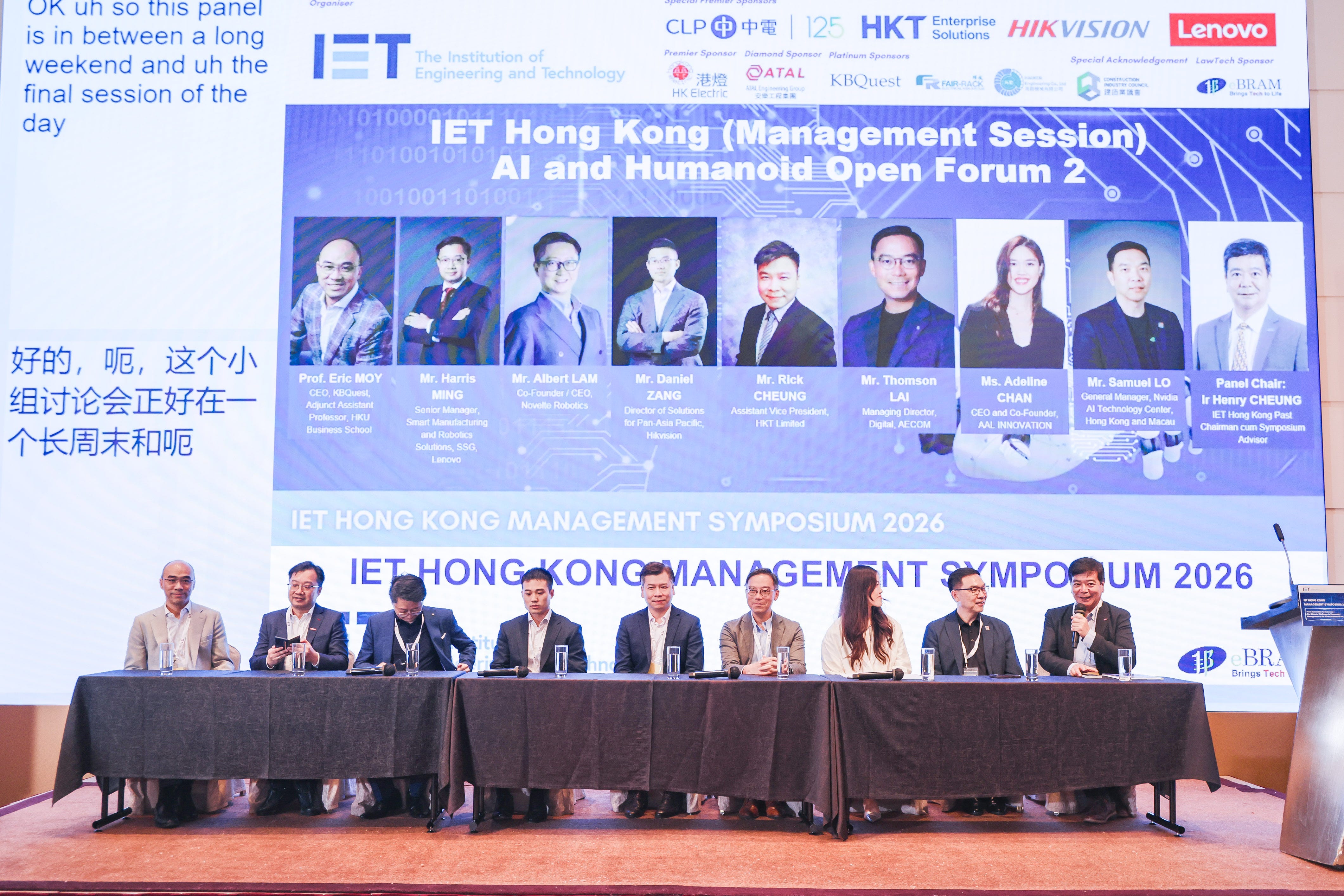
Here are the key observations Adeline shared from 2-3 years of working at the intersection of AI, real estate, architecture, engineering, construction, and operations.
1 - The Adoption Gap Nobody Talks About
One of the most persistent tensions in enterprise AI adoption is not technological — it is organisational. Senior management wants their teams to implement AI. But frontline workers are frequently not given the time or resources to actually do so. The mandate comes from the top; the bandwidth does not follow.
This gap is not a technology problem. It is a management problem, and it will not be solved by better tools alone.
2 - Why Company Size Matters More Than You Think
AI adoption does not look the same across organisations, and the differences are more structural than most leaders acknowledge.
Large corporations tend to do well. They have unified data infrastructure, dedicated R&D budgets, and the organisational weight to enforce adoption. Small companies, by contrast, are lean enough to pivot fast — they learn quickly and become competitive precisely because they are not encumbered by legacy processes.
It is the mid-sized company that often struggles most. They have neither the data infrastructure of a large enterprise nor the agility of a small firm. They sit in a difficult middle ground where AI adoption requires the most deliberate strategy and the most careful resource allocation.
3 - Three Formats of AI Adoption
For organisations at any scale, AI adoption typically takes one of three forms:
Proof of concept — internal pilots that test feasibility before committing resources
Service — engaging AI consultants or professionals who can deploy AI within existing workflows
Training — upskilling staff through structured AI workshops so the capability is built in-house
The right format depends on the organisation’s readiness, risk appetite, and strategic timeline. Most organisations will move through all three over time.
4 - What the Future Looks Like — In Brief
The macro trajectory is becoming clearer. Heavy investment in AI is coming from companies of all sizes. As AI reshapes workflows, company structures will reorganise — and as company structures change, so will the culture of the office. And as office culture shifts, the real estate industry transforms with it.
We are already seeing the early signals: commercial real estate demand evolving, data centre investment accelerating, and the entire ecosystem of real estate consultancy, engineering, and architecture adapting to a fundamentally different operating environment.
This transformation operates at three scales simultaneously:
The individual — new job roles emerging, existing roles being redefined
The company — size, structure, and nature of organisations shifting
The industry — sector-wide transformation of how work is organised and delivered
5 - The Risk of Not Taking Risk
Perhaps the most important point raised: in the current AI landscape, the conversation rightly focuses on the risks of AI doing harm, or of people using AI irresponsibly. These are real concerns that deserve serious governance frameworks.
But there is an equally important and often overlooked risk on the other side: not acting is itself a risk. Organisations that delay meaningful AI adoption while waiting for perfect conditions are not playing it safe. They are falling behind in a competitive environment where the gap between early adopters and late movers is widening every quarter.
A budget line item for AI transformation is no longer optional. It is a strategic necessity.
AAL works with organisations in the AEC and real estate sectors on AI readiness, implementation strategy, and workforce upskilling. To learn more, visit aalinnovationai.com or reach out at team@aalinnovationai.com.
Best regards,
Natalie Gusawir
COO
AAL INNOVATION